
TV Mounting in St. Catharines: Get Your Living Room Grey Cup Ready (2026 Guide)
October 19, 2026
IKEA Canada’s 50th Anniversary Sale in Ontario: Smart Buying & Furniture Assembly Guide (2026)
October 20, 2026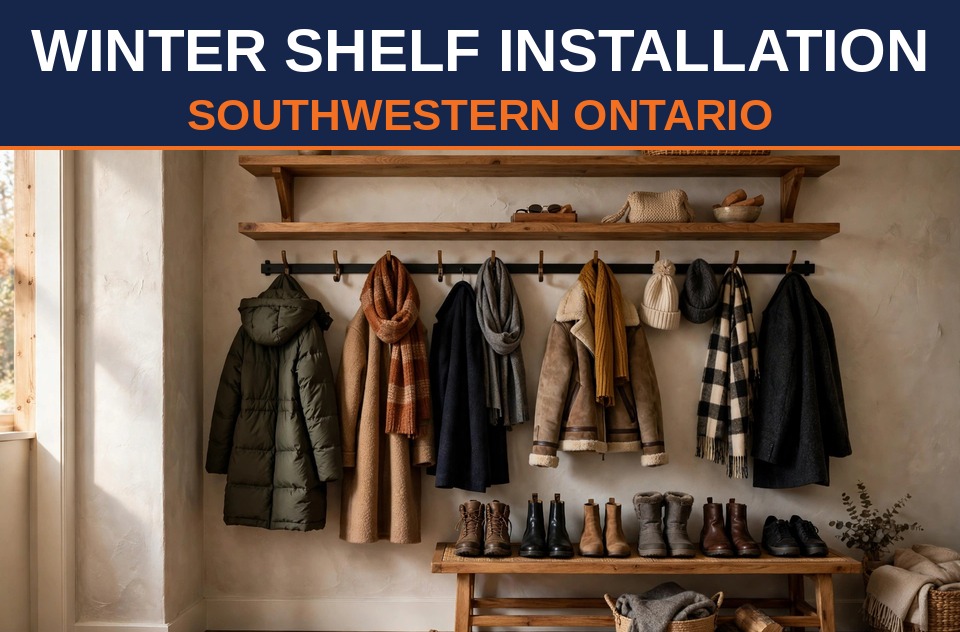
Winter-Ready Entryways in Southwestern Ontario: Shelf, Hook & Bench Installation Done Right (2026 Guide)
The coats came out of the closets this week. With overnight lows dipping toward frost across Southwestern Ontario — patchy frost is already forming on windshields from St. Catharines to London — the entryway is about to become the busiest room in the house. And most of them are not ready for it.
Summer is forgiving: one pair of sandals, one light jacket by the door. Winter doubles the gear per person — heavy coats, boots, scarves, hats, mitts. A family of four produces a doorway avalanche by November. The fix is straightforward: a properly installed shelf, a solid coat hook rail, and a storage bench with cubbies. But “properly installed” is doing a lot of work there, because a hook rail loaded with four wet winter coats will rip straight out of drywall if the mounting is wrong.
Think of the entryway as three zones: a drop zone at floor level (bench with cubbies or a boot tray that contains wet footwear), a coat zone at 150–165 cm (a hook rail that carries the family’s outerwear), and an overhead zone (a shelf for hats, gloves, and bags). Get those three right and the doorway stays clear of trip hazards all winter.
Measure Before You Buy Anything
The single biggest mistake people make is buying the pieces first. Measure the usable wall beside the door, accounting for the door’s swing arc — a shelf that blocks a door swing is a hazard, not storage. Standard 8-foot ceilings leave about 90 cm of wall above a hook rail for a shelf. Keep the depth budget in mind: a bench can stick out 40–45 cm; deeper blocks the narrow foyers common in older Kitchener and London semis. A 120 cm wide wall comfortably fits a three-cubby bench, a 6-hook rail above it, and a shelf above that.
Shelves That Actually Hold Winter Gear
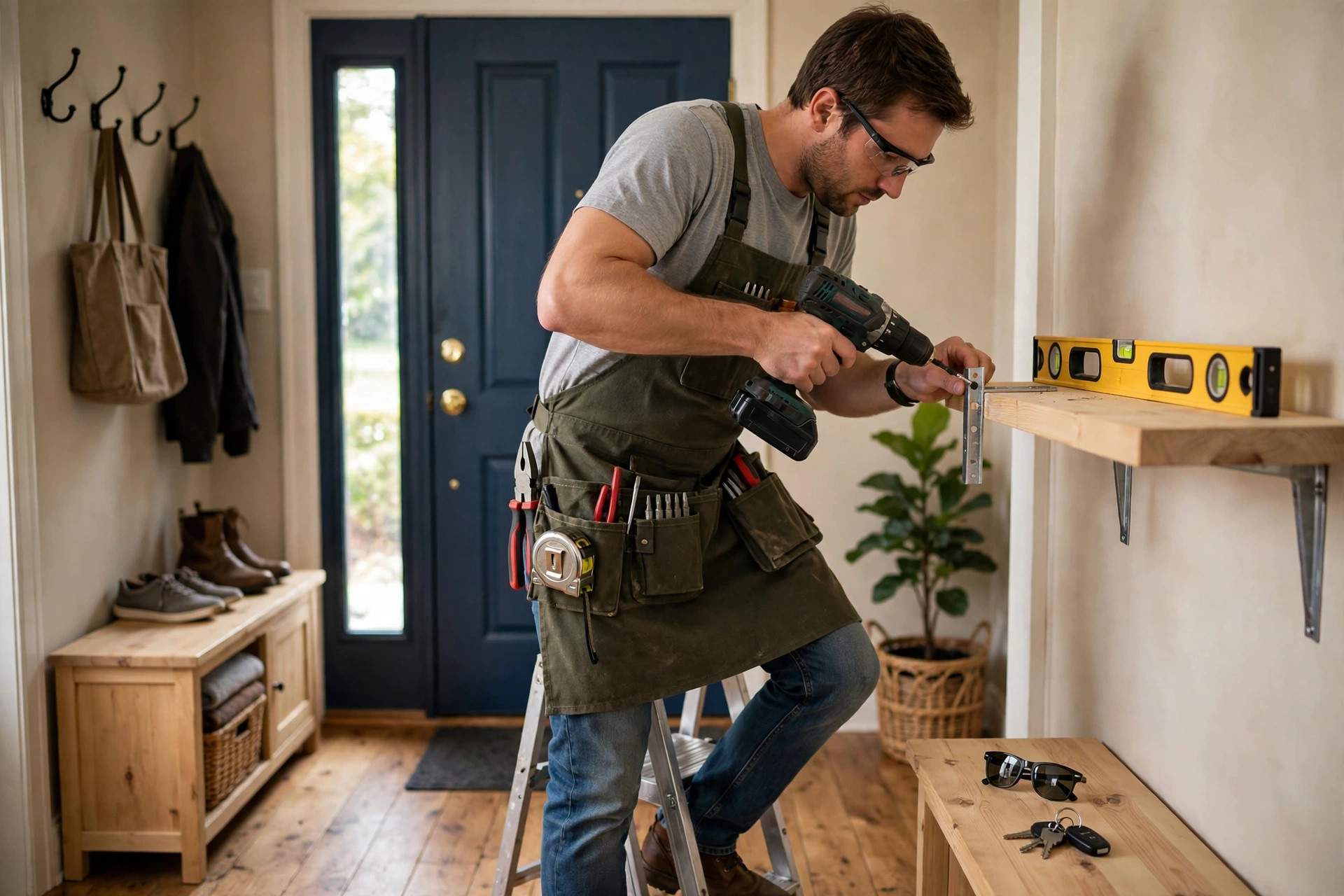
An entryway shelf isn’t decorative — plan for 10–20 kg of load on a standard 120 cm shelf. Bracketed shelves are the honest choice: steel or solid-wood brackets every 60–75 cm, screwed into studs wherever possible, with snap-toggle or high-capacity drywall anchors where studs don’t line up.
Mount the shelf 25–30 cm above the hook rail — room for coats to hang without bunching, while hats and gloves stay reachable. With hooks at 160 cm on a standard wall, the shelf lands around 190–200 cm: reachable for most adults, and kids’ things belong on the lower hooks anyway.
Cost: a solid-wood or laminate shelf costs $25–$80 in materials; professional shelf installation in Southwestern Ontario runs $60–$120 per shelf, or $100–$180 for a pair.
Coat Hooks and Rails That Don’t Rip Out
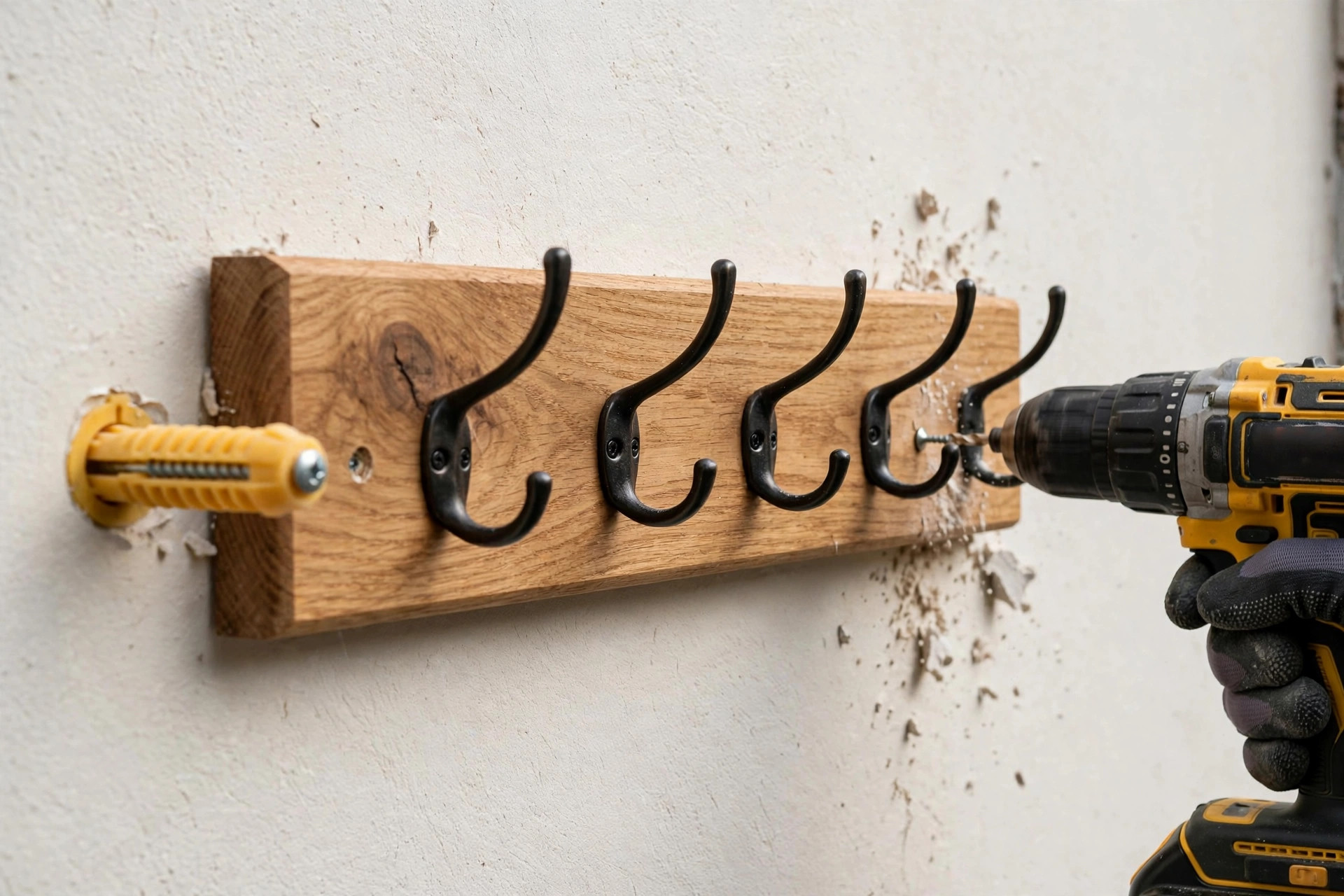
Hooks fail for exactly two reasons: wrong fasteners, and wrong spacing. A rail loaded with four heavy coats pulls 8–15 kg downward and outward, concentrated on two or three screws.
Screw the rail into at least two studs — the gold standard. When studs don’t cooperate, as they often don’t in older plaster-and-lath homes, use snap-toggle anchors rated 30 kg+ each, never the 5-kg plastic plugs that come in the box with cheap hooks.
Space hooks 20–25 cm apart so bulky winter coats don’t overlap and jam. Mount the rail at 150–165 cm for adults, and add a second row at 100–110 cm if kids will hang their own coats — it genuinely changes behavior.
Cost: a quality 6-hook wooden rail costs $25–$60; professional installation in Southwestern Ontario runs $40–$80 for one rail, $70–$120 for two rows.
The Storage Bench (and Why It Must Be Anchored)
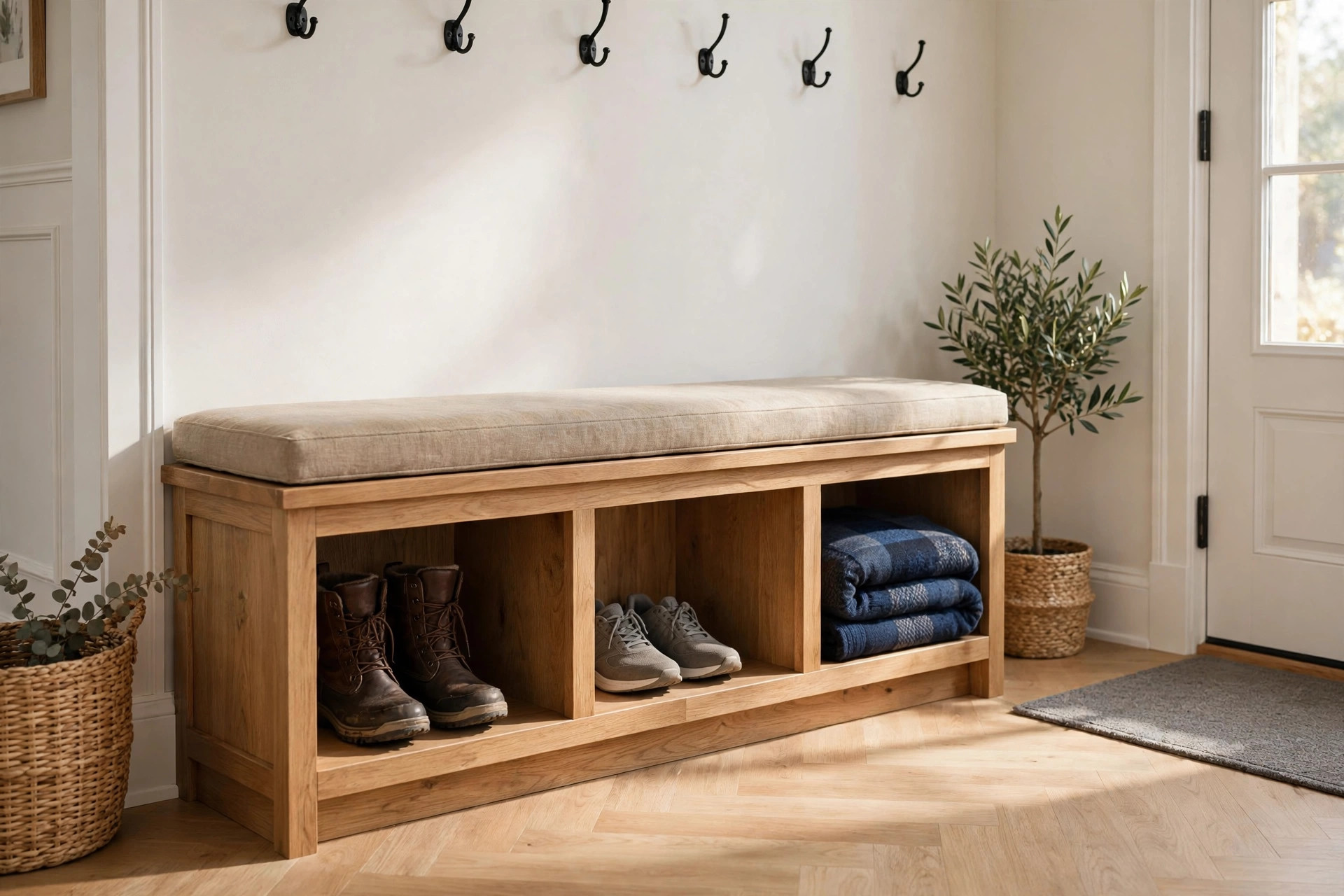
The storage bench is the anchor piece: seating for pulling on boots, cubbies for shoes, and a surface that catches keys and mail. Flat-pack benches from IKEA, Wayfair, and Canadian Tire run $80–$250, but nearly all include an anti-tip kit that people throw away. Don’t. A 90 cm bench loaded with boots on one side is top-heavy, and a climbing toddler can tip it forward.
A handyman assembles these in 30–60 minutes, levels them on uneven floors, and screws the anti-tip strap into a stud — typically $80–$150 for assembly plus anchoring. It’s a sensible add-on to a shelf-and-hook visit, which is why local pros like BuildNest bundle the whole entryway as one job.
Boot trays are non-negotiable. Wet boots drip, and meltwater pooled on hardwood or laminate ruins finishes within a season. Slide a $10–$20 rubber tray into each cubby or under the bench, and rinse it every week or two — dried road salt creeps onto the floor around them.
Southwestern Ontario Wall Quirks
- Plaster-and-lath (pre-1960s homes in London, Stratford, older Kitchener/Woodstock). Thick, hard, brittle. Pre-drill with a masonry bit, use toggle-style anchors, and never hang a loaded hook rail on lath alone.
- Drywall over wood studs (most post-1970s homes). Find the studs; where you can’t hit one, snap-toggle anchors are the reliable choice.
- Concrete or block walls (basement entries, some townhouses). Needs a hammer drill, masonry bits, and concrete screws — the one scenario where most DIYers should call a pro, since a hammer drill rental alone can cost more than the install.
What a Full Entryway Setup Costs in 2026
| Piece of the job | Typical cost (installed) |
|---|---|
| One entryway shelf | $60–$120 |
| Pair of shelves | $100–$180 |
| One 6-hook rail | $40–$80 |
| Two rows of hooks | $70–$120 |
| Storage bench assembly + wall anchoring | $80–$150 |
| Complete 3-zone entryway package | $200–$400 |
A full package usually takes a pro 2–3 hours door to door. DIY is firmly doable too — a Saturday afternoon with a drill, a level, a stud finder, and confidence about what’s behind your walls.
The honest note: the most common DIY outcome isn’t damage — it’s delay. The shelf sits in its box for three months and the entryway stays chaotic until February. If that sounds familiar, booking a shelf and hanging installation service now, while temperatures are still mild enough to work comfortably, beats a mid-January scramble.
FAQ: Winter Entryway Storage Installation
How much weight can an entryway shelf hold?
A properly installed 120 cm bracketed shelf on studs handles 15–25 kg; on snap-toggle anchors in drywall, plan for 10–15 kg. Floating shelves vary — check the hardware rating, and halve decorative ratings for real loads like bags and blankets.
Do coat hooks really need to hit studs?
Something has to carry the load. Two screws into studs are the gold standard; high-quality snap-toggle anchors are a legitimate second choice in drywall. Plastic expansion plugs under a winter-coat load are the failure mode you see in every “my hook rail fell off” story.
What’s the best height for entryway hooks?
150–165 cm for adult coats, 100–110 cm for kids. The shelf goes 25–30 cm above the adult row. Hold a coat against the wall before marking — a winter parka hangs 110–130 cm from its collar, so the hem should clear the bench below.
Can you install shelves on plaster walls?
Yes, with care: pre-drill with a masonry bit at low speed and use toggle-style anchors rather than expanding plugs that can crack the plaster keys. Heavy setups should hit a stud wherever possible. Unsure what’s behind the plaster? Get a local pro in.
How long does a full entryway installation take?
A professional typically finishes the shelf-plus-rail-plus-bench package in 2–3 hours, including assembly, leveling, anchoring, and cleanup. If you’d like it done in one visit, 905-519-1011 is the number folks around here call for this kind of work — an entryway package is exactly the sort of small bundled job BuildNest handles.
Frost is already showing up on windshields across Southwestern Ontario this week, and the full weight of winter gear lands in entryways within days, not weeks. A weekend of measuring and mounting now — or one pro visit — buys you a calm, organized doorway from November through March. That’s a good trade.